

The US spends twice as much on health per person as other high-income nations. Health expenditures per person reached $13,432 in 2023, which was over $3,700 more than any other peer nation.
According to the Commonwealth Fund, “reductions in administrative burdens and drug costs could substantially reduce the difference between U.S. and peer nation health spending.” However, the US continues to struggle with opaque pricing structures that harm patients and providers alike.
The Centers for Medicare & Medicaid Services (CMS) hospital first took steps to address this with the introduction of the hospital price transparency law in 2021. The aim was to give patients and providers access to clear pricing information in order to reduce inflated costs. But in practice, the initiative has been hindered by inconsistent execution and a lack of enforcement.
More recently, CMS finalized significant updates to hospital payment and price transparency policies in its CY 2026 Hospital Outpatient Prospective Payment System (OPPS) and Ambulatory Surgical Center (ASC) final rule, signaling a clear intent to close loopholes and enforce transparency.
At PurpleLab, we welcomed the opportunity to engage with CMS through its Hospital Price Transparency (HPT) Request for Information (RFI). As a healthcare data platform deeply engaged in parsing and analyzing hospital pricing files, we understand both the promise and the current pitfalls of this data.
Our aim in responding was to help make the system better for everyone, from regulators to hospitals to patients
Why This Matters
Hospitals are under increasing pressure to comply with these regulations, but the bar for compliance is higher than many realize.
Under the CY 2026 OPPS/ASC final rule, CMS finalized several changes that materially strengthen hospital price transparency requirements. These include expectations that hospitals:
-
Post real, consumer-usable prices, not estimates
-
Represent payer-specific negotiated charges more accurately
-
Use standardized formats that allow prices to be compared across hospitals and health plans
-
Face civil monetary penalties for noncompliance
These changes will ensure that pricing information is standardized and easily comparable across hospitals and health plans – the goal of Executive Order 14221.
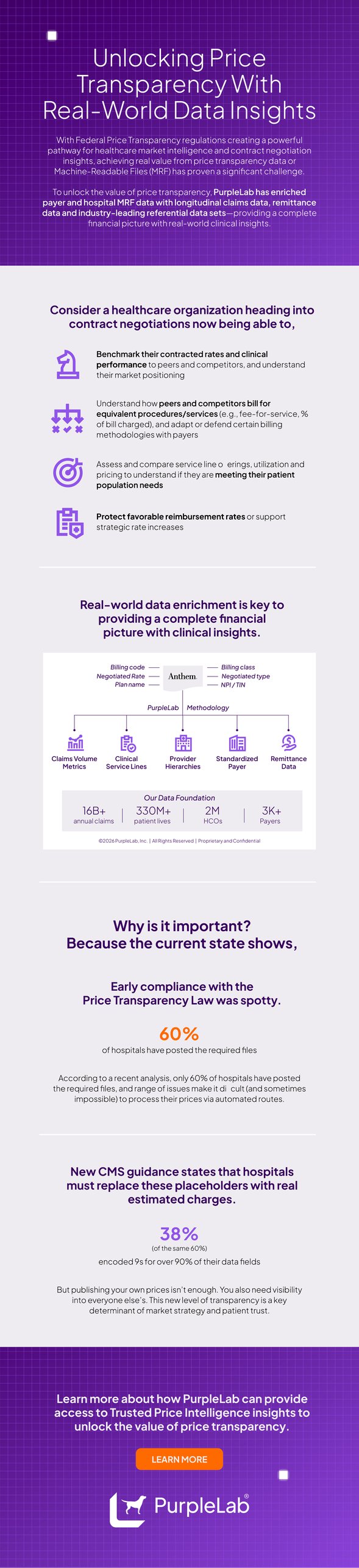
However, our internal analysis shows that nearly 40% of hospitals are still out of compliance, either because their files are missing, formatted incorrectly, or simply unreadable by CMS’s own validation tools.
Among the remaining 60% of hospitals that have posted the required files, a range of issues make it difficult (and sometimes impossible) to process their prices via automated routes.
Common Barriers to Automated Processing
Here are a few common examples of what we see in the field:
- Some hospitals use different versions of their names across their websites, TXT files, and MRF files, which makes it difficult to ensure an automated processor can accurately match files/prices to the right hospital.
- Hospitals put their files behind anti-bot protection, which prevents automated web scrapers from downloading them.
- Many hospitals are either not posting the required “TXT” index file at the root of their websites or are posting versions that don’t comply with the specified format. This prevents processors from being able to find and download the latest price files.
- A significant proportion of otherwise properly formatted files include billing codes that don’t conform to the industry standard code sets (e.g., a CPT code that doesn’t exist in the code set, using the ambiguous “DRG” as a billing code type, which could refer to MS-DRG, APR-DRG, etc.).
- The CMS rules require a specific format for Machine Readable File (MRF) filenames that incorporates a hospital’s EIN and name. Many hospitals are not following that format and are instead using arbitrary names that omit important identifying information about the file.
- Because there is no standardized crosswalk of insurance payer and plan names, hospital files are filled with garbled or eccentric payer and insurance plan names that prevent pricing from one hospital from being easily compared against another. Many hospitals confound the issue by adding numeric IDs and other meaningless information into plan and payer names.
What PurpleLab Recommended to CMS
In our RFI comments, we focused on practical and scalable recommendations that can help the healthcare ecosystem move forward:
- Define “data accuracy” and “data completeness” more clearly so hospitals understand what good data looks like.
- Standardize billing code and payer name conventions to reduce ambiguity and make files interoperable across organizations.
- Validate in-network negotiated rates reported by hospitals against in-network negotiated rates reported by health plans.
- Engage and enable industry partners to support automated review and regular audit of MRFs. Relying on self-policing isn’t working.
We also urged CMS to take a more proactive enforcement stance. As long as penalties are rare and random, compliance will remain uneven. But by working with industry experts to audit and validate data programmatically, CMS can ensure better compliance – without increasing burden.
How This Fits Into the Bigger Picture
CMS has emphasized that consumers deserve pricing information they can actually understand and use, which means standardized and validated data. These updates also align with broader CMS efforts to modernize payments, reduce unnecessary spending, and support site-neutral care, reinforcing the role transparency plays in the future of value-based healthcare.
The HPT initiative doesn’t exist in isolation. CMS is also exploring reforms around prescription drug pricing, PBM transparency, and bundled payment models like TEAM (Transforming Episode Accountability Model). Taken together, these efforts show that the agency is pushing for comprehensive price accountability across the system.
For hospitals, this means transparency is no longer optional, and incomplete data is no longer good enough. In fact, if your data isn’t up to scratch, it’s probably a sign that the organization isn’t ready for the next generation of value-based care.
So, how should hospitals respond? Think beyond compliance. Use transparency as a way to gain operational insight and guide strategic planning.
That’s Where PurpleLab Comes In
At PurpleLab, we’ve partnered with Payerset – the leader in enterprise price transparency – to offer Trusted Price Intelligence, a solution built for hospital leaders who want more than just a file on a website.
With this combined solution, hospitals can:
- Benchmark their rates against peers and competitors.
- Track pricing trends by region, service line or payer.
- Spot outliers in contracted rates or reimbursement patterns.
- Support contract negotiations with payers using data-driven insight.
- Make capital investment decisions based on real-world utilization and cost data.
Reach out today to learn how Trusted Price Intelligence can turn regulatory complexity into actionable strategy.