

Seeing the Difference: One Patient's Timeline
The table above shows the difference in the abstract. The timeline below shows it for a single patient. Open claims (top) track office visits, imaging, and prescriptions continuously across six years, with occasional gray gaps where an event exists but wasn't captured. Closed claims (bottom) only exist inside that patient's enrollment window, but within it, activity across every claim type is confirmed and dense, including inpatient stays that never surface in the open claims view at all.
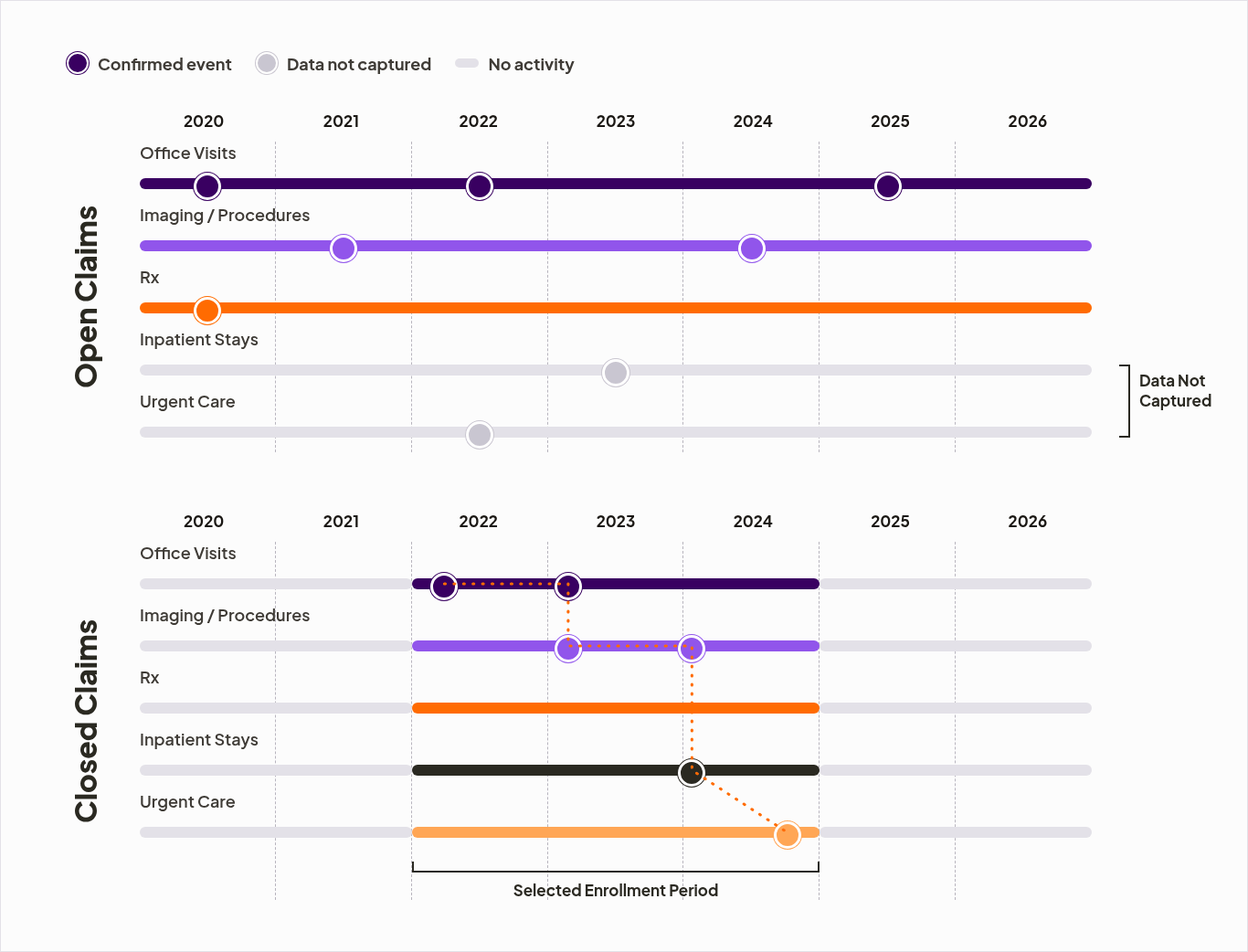
Illustrative example: open claims data (top) vs. closed claims data (bottom) for a single patient, 2020–2026.
Understanding Closed Claims Data
Closed claims data refers to medical activities recorded and supplied by health insurers. It pieces together a continuous timeline of a patient's healthcare usage during their active coverage, including routine outpatient consultations, emergency care, hospitalizations, and pharmacy transactions. This precision allows researchers and healthcare analysts to reconstruct patient journeys, linking their diagnoses and evaluating clinical outcomes.
Key Sources for Closed Claims
Because closed claims are sourced directly from the health insurer (payer), they break down into two straightforward categories: medical events (doctor's visits, urgent care, hospital admissions) and pharmacy fills (retail and specialty). Every one of these is comprehensively documented for a patient, as long as they stay within that enrollment period.
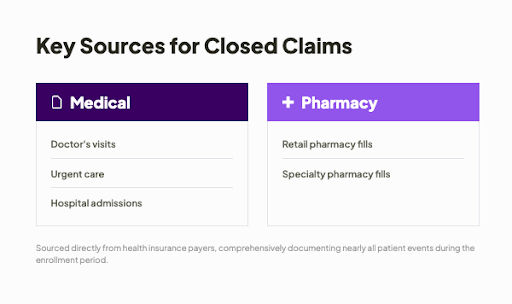
Key sources for closed claims data.
Closed Claims in Action
Closed claims offer a comprehensive view of patient interactions within the healthcare system during a coverage period. For instance, if a patient remains on the same employer-sponsored health plan for five years, almost all their healthcare activity throughout those years will be included, provided that the insurer’s data is part of the dataset.
However, when this patient switches employers and subsequently health insurance providers, interactions may not be captured in the closed claims dataset. This is the core continuity gap with closed claims, as it’s comprehensive within a plan, but not necessarily continuous across plans.
Consider a patient managing a chronic condition like rheumatoid arthritis. While enrolled in an employer plan, closed claims capture a rich, connected history: diagnosis, specialist visits, lab monitoring, and every fill of a biologic therapy. When that patient changes jobs and enrolls in a new payer's plan, that history doesn't travel with them — a researcher looking only at the new payer's closed claims might see a patient who appears to be starting biologic therapy for the first time, when in fact they've been on it for years.
Open claims data is a collation of a patient’s medical and prescription activity drawn from a range of sources, including software platforms, clearinghouses, and pharmacies. It can also include other data types, such as lab results, though these follow less consistent formatting and coverage than medical or pharmacy claims.
Key Sources for Open Claims
Open claims pull from a network of sources outside the payer. Medical events route through practice management systems, billing systems, and clearinghouses or switches, while pharmacy activity flows through pharmacy benefits managers (PBMs), pharmacy management systems, and those same clearinghouses or switches. Because these sources overlap, a gap in one clearinghouse's coverage can affect visibility across both medical and pharmacy claims.
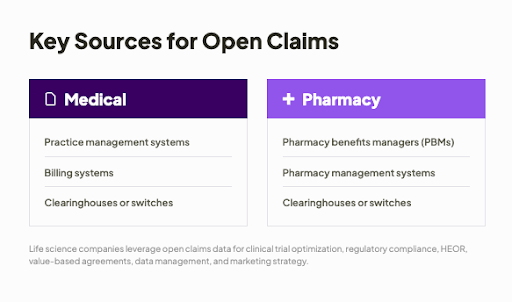
Key sources for open claims data.
- Open medical claims: These can be captured through various means, including recording patient visits in practice management systems (PMS), billing systems, and more. Data transmission occurs when doctors submit medical claims (837) through clearinghouses or switches to insurance providers, with reimbursement decisions captured in remittances (835).
- Open pharmacy claims: These claims are captured in pharmacy management systems and by pharmacy benefits managers (PBMs). After claim authorization and adjudication by insurance providers, additional data may pass through clearinghouses or switches during medication dispensation.
A clear advantage of open claims data is its recency. Medical, pharmacy, and lab activity can be accessed before the payer completes its adjudication process, enabling faster reporting and tracking. Adjudication is a process through which a payer reviews a claim and determines whether and how it will be paid. Because open claims can be accessed before this process is complete, researchers can monitor healthcare activity without waiting for a payer's claims cycle to close.
Apart from medical events, open claims data can include clinical and administrative details such as:
- ICD-10 and CPT codes
- Billing information
- Physician details
- Referring NPI
- Service locations
These data support several applications across the life sciences, including health economics and outcomes research (HEOR), clinical trial optimization, data governance, value-based agreements, marketing, and regulatory activities.
Open claims are provider centric, and the gaps tend to concentrate in specific places. Independent and rural practices, for instance, more often route through smaller, regional clearinghouses rather than the handful of national switches that dominate larger health systems. A specialty clinic that recently changed billing vendors, for example, may show a visible claims history up to the switch date and then a gap right after it, even though the clinic never stopped seeing patients.
That gap doesn't mean the data doesn't exist; PurpleLab may have coverage for that same provider through its closed claims data set. These kinds of discrepancies are common in open claims data, which makes closed claims a necessary complement to open claims, rather than a substitute for it.
Choosing the Right Claims Data for Your Team
The ideal data set depends entirely on your specific research goals. Here is how open and closed claims map to the distinct needs of life sciences, payer, and provider teams.
For Life Sciences & Pharma
Pharma teams tend to reach for open claims when they need longitudinal visibility that isn't tied to a single payer, be it tracking a patient's full treatment journey across providers for HEOR, identifying trial-eligible patients early via pre-adjudication data, or measuring referral patterns ahead of a launch. Closed claims come in for confirming adherence and persistence within a defined enrollment window, and for payer-mix and market-access analysis.
For Payers
Payers naturally have closed claims as their core asset. The strategic value of open claims for a payer is in filling in the picture outside their network: understanding what members are doing when they're out-of-network, or benchmarking against broader market activity that isn't visible in claims the payer itself adjudicated.
For Providers
Providers use closed claims (often via payer partnerships or all-payer claims databases) to understand total cost of care and where patients are going for care outside the system. Open claims help fill referral-pattern gaps and support network growth and benchmarking initiatives, since they aren't limited to a single payer relationship.
Regulatory Considerations for 2026
Claims data, open or closed, is subject to an evolving set of federal privacy and de-identification standards, and 2026 has brought incremental but meaningful shifts worth flagging for teams building compliance workflows around this data:
- De-identification standards for medical devices: On December 15, 2025, the FDA announced it would finalize updated guidance, formally issued December 18, on the use of real-world evidence (RWE) in medical device submissions, removing its prior expectation that sponsors submit identifiable, patient-level data. This opened the door to large de-identified claims and registry-based datasets for select device submissions.
FDA will accept RWE without always requiring identifiable, patient‑level data collected from real‑world data sources to be submitted in the marketing application, and will evaluate RWE case-by-case for fitness of purpose.
The update applies specifically to medical devices; FDA has indicated it intends to consider similar guidance for drugs and biologics in the future, but drug sponsors should continue engaging the FDA case-by-case in the meantime.
- International harmonization (ICH M14): In March 2026, the FDA adopted ICH M14, the harmonized international guidance on planning, designing, analyzing, and reporting non-interventional studies that use real-world data for drug safety assessment, developed jointly with EMA and Japan's PMDA.
- Data provenance and consent: As open claims data draws from a wider set of non-payer sources, documenting provenance and the basis for use becomes more important for downstream research and regulatory submissions.
These shifts redefine what makes RWD 'submission-ready.' While the device guidance eases privacy hurdles for de-identified data, ICH M14 requires sponsors to demonstrate explicit data provenance, quality assurance, and study pre-specification. Navigating these standards requires RWD infrastructure built for auditability—allowing research teams to justify their data source with confidence, whether leveraging open, closed, or linked claims datasets.
How to Choose: A Decision Guide
Use this as a quick gut-check when scoping a project:
- Need to follow a patient across providers and payers over years? Start with open claims.
- Need a complete, confirmed picture of everything that happened during a specific enrollment period? Start with closed claims.
- Need the most current, near-real-time signal? Open claims, since much of it is available pre-adjudication.
- Need certainty that adherence/persistence claims are backed by adjudicated data? Closed claims.
- Running a longitudinal study that also needs enrollment-period depth (e.g., oncology patient journeys)? Combine both data sets.
In most sophisticated research designs, the honest answer is "both." Open claims and closed claims cover each other's blind spots.
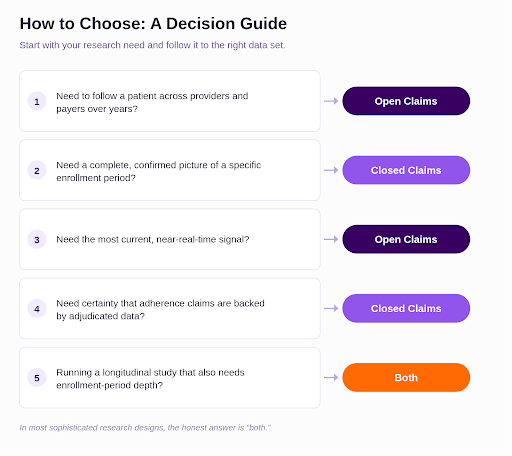
Decision guide: match your research needs to open claims, closed claims, or both.
Tracking Patient Activity for Various Use Cases
In oncology research, building the complete picture requires data from different stages of the patient journey. Both open and closed claims contribute unique insights into different parts of that picture.
Open Claims Focus on Long-term Patient Care: Open claims collate data from various healthcare settings independent of insurance plans, allowing for longitudinal studies over an extended period. They can reveal oncology diagnoses, treatments received, and referrals.
Closed Claims Provide Comprehensive, Fixed-Window Data: Closed claims ensure a comprehensive examination of the oncology patient journey, giving researchers greater confidence in assessing treatment adherence. This data includes almost all patient interactions during the enrollment period, including oncology-related events and other activity.
Combining Claims Data for Greater Insight: Integrating the two datasets extends the patient history beyond the coverage window while preserving the depth of records pulled from specific insurers. Researchers can then examine patient actions and treatments before, during and after enrollment period. This will allow for a rich history leading up to the diagnosis as well as the actions during enrollment. Combining open and closed claims data sets provides greater insight into patient behaviors, diagnoses, treatments, and adherence.
Overall, open and closed claims are both indispensable for patient-centric research. While open claims excel at longitudinal studies and surface fields absent from closed claims; closed claims provide a concise, confirmed snapshot over a defined period. Used together, both datasets strengthen outcomes research and sharpen the accuracy of the insights life sciences, payer, and provider teams depend on.
FAQ: Open vs. Closed Claims Data
What is the main difference between open and closed claims data?
Closed claims data comes directly from health insurance payers and covers nearly all of a patient's activity within their enrollment period. Open claims data comes from clearinghouses, pharmacies, and other non-payer sources, and follows a patient across providers and payers over a longer period of time, independent of a single insurance plan.
Which is more accurate, open or closed claims data?
Neither is more "accurate"; they're comprehensive in different ways. Closed claims are comprehensive within an enrollment period, while open claims are comprehensive across time and provider relationships, but can have gaps where a provider's claims route through a clearinghouse that isn't included in a given data set.
Can open and closed claims data be used together?
Yes. Combining the two is common practice, particularly for longitudinal studies like oncology patient journeys, since it captures activity before, during, and after a specific enrollment period.
Why would a pharma company use open claims data instead of closed claims data?
Open claims data is often available pre-adjudication, meaning it can support faster reporting and earlier signal detection. It’s useful for clinical trial recruitment, HEOR, and tracking a patient's full treatment journey across multiple providers rather than a single payer's network.
Is closed claims data limited to one insurance provider?
Closed claims data is tied to a specific payer and enrollment period. If a patient switches employers or health plans, their prior activity may not carry over into the new payer's closed claims data set, which is why continuity gaps can appear at plan-change points.