


A G35 diagnosis rarely marks the beginning of a patient's story — it marks the end of a long, often invisible road to get there. Using nothing but claims codes, we reconstructed one MS patient's 26-month journey: no chart notes, no interviews, just the trail the data left behind.
When a patient is finally diagnosed with multiple sclerosis, the G35 code on their record is usually the last chapter of a long, arduous and often invisible story — not the first. For months, sometimes years, patients live with vague symptoms, cycle through specialists, undergo inconclusive tests and take medications meant for the wrong condition, all before MS is ever named.
Almost all of that story is already written down — not in a chart, but in claims data, waiting to be read. At PurpleLab, we set out to prove exactly how much of a patient's road to diagnosis enriched real-world claims can reveal.
From the first ankle pain to the first MS medication, we rebuilt a near-complete clinical narrative — without a single chart note.
Working only from claims codes — open, closed, medical, pharmacy and specialty — we reconstructed the timeline of one MS patient across a 26-month window. What emerged reads like a clinical case history, assembled entirely from the breadcrumbs the healthcare system records by default.
THE FINDING
Twenty-two months between the first symptom and the first answer
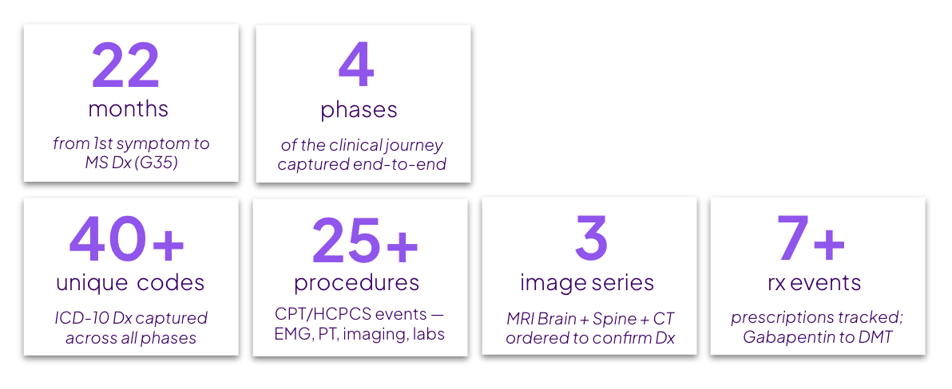
Our patient waited 22 months between her first symptom and her first MS diagnosis code. In that span, claims captured more than 40 unique ICD-10 codes, 25+ procedures and 7+ prescription events — each one a breadcrumb that, in hindsight, points straight toward demyelinating disease. The trail broke cleanly into four phases.
Phase 1 - Pre-diagnostic symptom onset (Jan 2021 - May 2021)
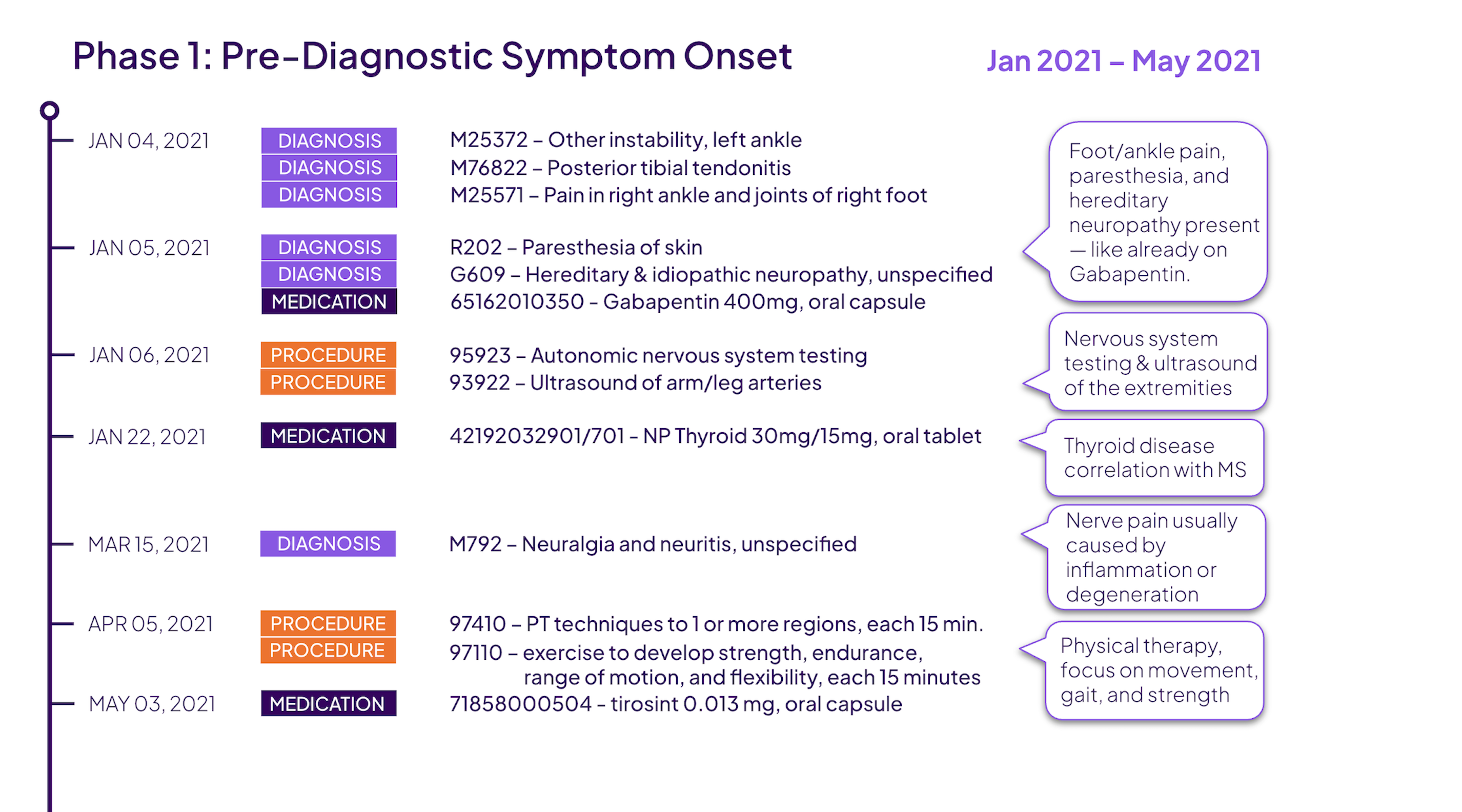
The story began with vague systems affecting the patients’ feet and ankles. On January 4, 2021, three orthopedic codes appeared: ankle instability, posterior tibial tendinitis and joint pain in the right foot. The following day, paresthesia (R20.2) and unspecified hereditary neuropathy (G60.9) were logged. By the end of the week, autonomic nervous system testing and an ultrasound of leg/arm arteries had been performed. Within three weeks, the patient is prescribed thyroid medication.
None of these symptoms on their own necessarily scream MS, but together they form a recognizable pre-diagnostic pattern. Bilateral foot pain, paresthesia, neuropathy and thyroid disease (a known MS comorbidity) all appearing within days of each other and treated symptomatically, is the kind of signature that pattern-recognition models can flag prospectively when trained on enriched longitudinal claims.
Phase 2 - Diagnostic workup – Escalating complexity (May 2021 - May 2022)
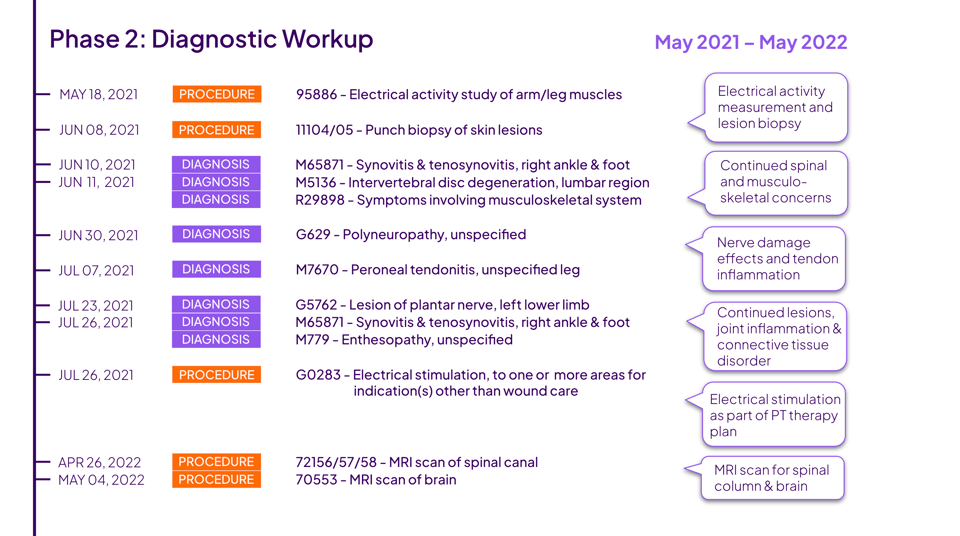
The following year of the patient’s journey shows a workup that intensifies without resolving. Electrical activity studies of the muscles (95886), punch biopsies of skin lesions (11104/05), additional neuropathy codes, lumbar disc degeneration, plantar nerve lesions, and a course of electrical stimulation as part of physical therapy. By mid-2022, the patient still isn’t close to a diagnosis, despite almost 18 months having passed since initially reporting symptoms.
On April 26, 2022, when the patient receives an MRI series of the spinal canal (72156/57/58), followed eight days later by an MRI of the brain with contrast (70553). In claims data, this exact sequence – full spinal MRI followed quickly by contrast-enhanced brain MRI – is a strong proxy for clinical suspicion of CNS demyelination, months before any MS code is assigned.
Phases 3-4 - Diagnosis confirmed and treatment initiated (Oct 2022 onward)
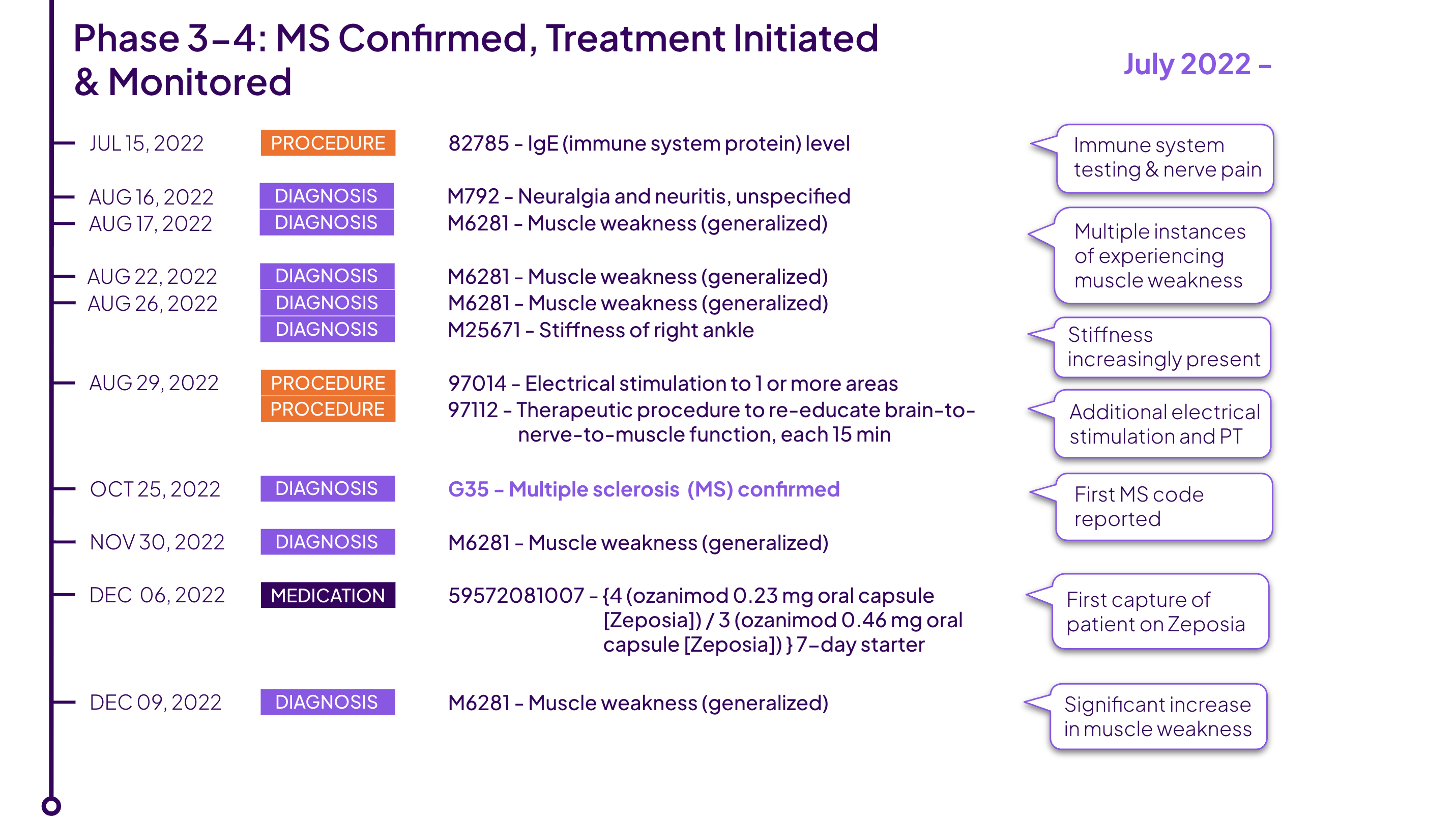
In late summer 2022, generalized muscle weakness (M6281) begins appearing repeatedly alongside nerve re-education therapy (97112). On October 25, 2022, the first G35 – the primary classification for multiple sclerosis – appeared on the record. Six weeks later, on December 6, 2022, a Zeposia (ozanimod) 7-day starter pack was dispensed. Persistent muscle weakness codes continue after treatment initiation, suggesting ongoing disease burden visible entirely through claims.
WHY IT MATTERS
Four things claims data does reliably — and at scale
One patient's trail, read end-to-end, points to capabilities that hold across any therapeutic area.
1. Pre-diagnostic signals are visible
Foot pain, bilateral neuropathy, paresthesia and gabapentin use — all appearing more than a year before G35 — form a classic pre-MS pattern that is identifiable in open claims with very little lag.
2. Diagnostic escalation leaves a trail
The ordered sequence — autonomic nerve testing → EMG → skin biopsy → spinal MRI → brain MRI — maps directly onto neurology workup protocols, and is detectable from CPT codes alone.
3. Drug initiation & adherence are trackable
Pharmacy claims provide a continuous medication history — from early gabapentin refills through Zeposia initiation — tied to the clinical milestones happening in parallel.
4. Open + closed claims close the picture
Open claims capture the breadth and recency of early symptomatic encounters; closed claims confirm diagnoses and treatment. Together they deliver a complete 26-month view neither could alone.
UNDER THE HOOD
The data sources powering this journey

FOR THE ECOSYSTEM
What this means across the healthcare ecosystem
One MS journey is a single example — but the analytical capability behind it generalizes to every stakeholder PurpleLab serves. Pick your vantage point.
Payers and Providers
Find the months where earlier intervention is possible
Journeys like this one show precisely where the gap between symptom onset and specialist referral opens up. That visibility is exactly where care management, quality programs and earlier referral pathways can compress the road to diagnosis.
- Spot referral delays prospectively
- Benchmark workup pathways
- Quantify avoidable care
Life Sciences
See the real-world landscape your drug is launching into
Reconstructed journeys reveal the symptomatic drugs patients are already on, the specialists making the diagnosis, and the timing of therapy starts and switches — the clinical and competitive context behind every launch.
- Map treatment and switch timing
- Identify diagnosing specialists
- Understand prior-therapy mix
Advertising
Reach the right audience at the right clinical moment
The same privacy-centric signals power clinically precise audience segments, letting pharma marketing teams reach patients and HCPs at the moments in the journey where education and engagement will have the most impact.
- Moment-based segmentation
- HCP and DTC targeting
- Understand care and referral pathways
Stitched together with the right data model, claims stop being fragments and become a clinical narrative — one detailed enough to recognize conditions like MS in retrospect and, increasingly, in prospect. That is what PurpleLab's enriched claims data is built to do: turn the scattered record of a real patient's journey into evidence teams can act on.
Curious what your patient population looks like, stitched together from first symptom through treatment and beyond? Let’s construct it together.